Sunday, 27 September 2015

What Lay People Should Know about The Scientific Method – The Investigative Process

by Zad Datu


Preceding related article (Read first!):
What Lay People Should Know about The Scientific Method – Hypothesis vs. Conjecture


If you read the previous article, once again, I would like you to forget all scientific jargon and imagine the same scenario. If you haven't read the article, imagine the following scenario:

One night I was in the jungle and a creature of significant size attacked where I managed to escape leaving only a scratch on my shoulder. I could not identify the creature at all. The following day I hired a team of investigators to solve this mystery. Following procedures, they developed a first hypothesis, that is the creature was a large dog. They obtained a specimen (dog) of average height and weight for its breed, get it to scratch piece of animal flesh, of similar composition to my shoulder and then compare that scratch mark with the scratch mark on my shoulder. The results shows that the scratches doesn't match.

Does this prove that the creature is not a dog?

The answer is 'No'. This does not prove that the creature is not a dog. It only eliminates the hypothesis that states that the creature is a normal adult dog of that particular breed.

What needs to be done next is to test all the breeds of dogs of significant size in the same manner. In other words developing many more contradicting hypotheses then test and eliminate them one by one. Upon the tests, results for all breeds of the proved negative. Again, this doesn't eliminate that the creature isn't a dog of any breed. This only eliminates all normal sized dogs of all breeds as the possible culprit. It could be a mutant over-sized dog, but lets not go there just yet.

Moving on to the second speculation, the 'tiger-hypothesis'. Here, results proved positive - the scratch matches.

Does this prove that the creature is a tiger?

The answer is 'No', once more. This only proves that the hypothesis which states that the creature was a tiger has not been eliminated. After all, when a lion is placed to the test, the results also proved positive as expected since tigers and lions have very similar shape form and size. The creature can't be both a tiger and a lion at the same time.

Now, we have two leads to follow, and most likely other big cats of similar size would test positive as well. But before going into that, lets try to figure out how could a big cat end up in that. One possibility is through animal smuggling. To find out if this is the case, we need to investigate on the industry of animal smuggling in this area. Lets forget about this for now. Another possibility is that the big cat escaped from the nearest zoo. Easier to investigate upon and seemingly more plausible the investigators dive into this first. The investigators have discovered that there are lions and tigers in the zoo. There are no records of escaped tigers.

Does this eliminate the hypothesis that the creature is a tiger?

Again, 'No', it doesn't. It only eliminates the hypothesis that the creature is an escaped tiger from that zoo. This does not eliminate the hypothesis that the creature is a tiger from other sources, perhaps animal smuggling. On second thought, this also doesn't eliminate that the record from the zoo is incorrect. But for now let us assume that the zoo record is genuine.

The investigators then discovered that there is a record of an escaped lion. The lion escaped 7 days before the incident where I encountered the creature. The investigators would now have to consult a lion expert to find out whether an escaped lion from the zoo is likely to find its way to that jungle and how long it would take to get there. If it takes less then 7 days for the lion to reach the jungle this hypothesis still stands. Whereas if it takes more than 7 days, this hypothesis fails. To put this story to an end let us say the creature turned out to be that escaped lion and that the investigators have discovered that part of my ripped clothes were in the possession of that lion.

Now, let us restart the story all over again from where the investigators were hired. Let us say that instead of developing the 'dog' and the 'tiger' hypothesis, the first and only 'hypothesis' the came up with was that the creature is a bigfoot. This was then seconded by another member of the team, then a third. Out of anonymous decision and without further ado they pronounced the mystery solved and case closed. The creature was a bigfoot, they concluded.

Obviously, this is ridiculous. Apart from that fact, not only were they not bothered to place their 'hypothesis' to the test, they did not even bother to identify whether it is a hypothesis or a conjecture, or whether the properties of their speculation were definitive and measurable, which in this case they weren't. We can't obtain a specimen of bigfoot to put it to the test since we never caught one, hence bigfoot is an arbitrary concept. The speculation isn't hypothesis. It is a conjecture.

Even if bigfoot was a definitive and measurable property, and the speculation is a testable hypothesis. The method of how the investigators come to consensus is simply unreasonable and irrational. This isn't a reliable method to use as a source of information to confirm the credibility of one's conclusion of the incident even if the conclusion just so happen to be correct.

Though one may think that this second retelling of this investigation is ridiculous, this happens every now and then in casual conversations within many communities. When a group of people witness someone experiences mysterious symptoms upon his stay at an alleged haunted house, or when a friend claims to see things that other don't see, or perhaps when oneself see things which others don't see, it is very common for that entire group to mutually agree and conclude on single explanation without any process of investigation with a generic and arbitrary term, 'ghosts', often speaking of their conclusions as if they are as credible as proven factual information.
Print Friendly and PDF

Wednesday, 12 August 2015

What Lay People Should Know about The Scientific Method – Hypothesis vs. Conjecture

by Zad Datu


Forget about the term 'science' or 'scientific method for a moment'. Forget about all the scientific jargon and imagine the following scenario:

I was in a dark jungle late one night where I was attacked by a relatively large creature. I could not make out what the creature was nor its shape and form, but such size is not known to inhibit that jungle. Nevertheless, I manage to escape with only a scratch on my shoulder.

The following day I hired a team of investigators to uncover the mystery of this incident. As investigators do, they start of with speculations based on the story I told and the scratch mark on my shoulder. One speculation is that the creature was a large dog, another is that it could be a tiger, and the last speculation is that it was a bigfoot, none of which is known to inhibit the jungle.

The next stage is to see if they can put their speculation to the test. In the case of the 'dog-speculation', yes they can. They can obtain a specimen, a dog, and get it to scratch piece of animal flesh, usually that of pigs, of similar composition to my shoulder and then compare that scratch mark with the scratch mark on my shoulder.

Hence, this speculations is a Hypothesis - a testable speculation.

As of the second speculation, the 'tiger-speculation', we can also obtain a specimen and perform the same test. Both the 'dog-speculation' and 'tiger-speculation' are testable hypotheses.

How about the third speculation - bigfoot? Can we test this? Can we obtain a specimen, a bigfoot, and get it to scratch a flesh of similar composition to my shoulder and compare the results? No. Because we don't have a specimen. We never captured a live or dead bigfoot.

This speculation is a Conjecture - a non-testable speculation.

Both dogs and tigers are properties of the speculation based on discovered and studied upon life forms. The other property of the speculation, include the scratch itself which is also definitive and measurable. Hence this makes the speculation testable, a hypothesis.

Bigfoot is an alleged life form defined by the characterisation we give them as opposed to and not based on an actual captured specimen but rather on eye witness accounts and testimonies only. This makes it an arbitrary concept as opposed to a measurable definitive property. Hence this makes the speculation non-testable, a conjecture.

If something is based on an arbitrary concept, it is not testable. If it is not testable, it isn't provable. If it isn't provable, it wouldn't be reasonable give this conjecture equal credibility as proven factual information.

Those who assume that others being dismissive out of simple closed mindedness simply have not placed sufficient effort into this and other processes of reasoning.

Some seem to be quick to dismiss the credibility when others speak of arbitrary concepts such as bigfoot, ghosts, fairies, vampires, leprechauns, and so on. For some, this may be because they have placed sufficient rationalistic and reasoned thought before hand to notice the obvious, that these are conjectures and that it is unreasonable and irrational to give them equal credibility as proven factual information. Those who assume that they're being dismissive out of simple closed mindedness simply have not placed sufficient effort into this and other processes of reasoning to determine the credibility of the claims they're making.


Succeeding related article:
What Lay People Should Know about The Scientific Method – The Investigative Process
Print Friendly and PDF

Monday, 11 February 2013

What Lay Poeple Should Know about Synthetic Biology (video)

A short informative video about Synthetic Biology by TechNyou:


This are not my videos.
Print Friendly and PDF

Wednesday, 6 February 2013

Random Report: ONE Fighting Championship: Return of Warriors

by Zad Datu

After returning from ONE FC: Return of the Warriors on the evening of 2nd February, its very obvious that the standard of MMA in this region of the world is still low. MMA is still very fresh in this new market, so we can’t expect much and I will be looking forward to see it grow.


Coming from an underated martial art background (depends how you look at it) where there is (or was) virtually zero commercialising, that is mainstream karate, the first thing I noticed was that the standard of showmenship of the MMA fighters when making an enterance and celebrating their wins as well as their nicknames inproportionately outclassed their standards of fighting, thanks to the generally cocky (but extremely friendly) culture of USA as they took over the lead of MMA influence from Japan replacing the culture of humble confidence with theirs.

Most of the figthers were simply good enough to not make a fool of themselves. I know how it was to start out looking foolish in fights when I was new. Not to say that I am any better than them with these comment, but I do have my oppinions. There were some interesting fights but no impressive fighters thus far. I have a suspicion that part to blame for this is that perhaps it just never does look as impressive live as it does on TV (but the odd thing is in karate bouts it seldom looks as good on video recordings as how you remembered watchign it live).

Some of the fighters started training for MMA directly, some started out as Marital Arts purist from Silat, Wushu, Muay Thai and etc. whilst some were national and even world champions of speficic marital arts. Most were Malaysians but they were some from Japan, Vietnam, Thailand, USA, South Africa and Philipines (I hope I didn’t miss out on any nationalities). Surprisingly some of the standup based martial art purist entered MMA clearly didn’t prepare for ground fights or grappling fights. If they do not intend to play a ground fight, they should’ve atleast prepare to defend against ground fighters.

Anyway, on the positive side, there was a good armbar by Gianni Subba, a triangle choke which was a little hard to catch by Melvin Yeoh, a rear-naked choke by the anticipated Adam Kayoom followed by his comment on the respect which should be given to all these fighters who has sacrificed a lot and that he hasn’t seen his daughter who is only 5 months old as an example, and ended with “...we don’t need to listen to your bullshhh....” – a pre-resposne to what I’m have to say about these fighters. The most gruesome win was where Pete Davis smashed his heel against his opponent’s mouth, to be specific, who was attempting an anke lock. Leo Krishna from Indonesia ended with a chunk of his upper lip sliced appart while Pete Davis’s was heel cut open with blood gushing non-stop. Another beautiful win was a guilotine choke by Japan’s Shooto champion, Sinichi Kojima followed by a comical expression of relief and excitement during the interview in the ring just after his victory. He then snached the microphone off from Jason Chambers (yes, host of Human Weapon is a comentator here) just to say “TERIMA KASIH!”.

The final and most anticipated bout, Eric Kelly vs. Honorio Banario, turned out to be the worst of them all. Spectators couldn’t bare the the anticlimatic event as “boos” were given off here and there. They even lost interest in hooting for the ring girls up to this point. If I were to chose which match should’ve been the highlight, it would be between Sinichi’s bout and the South Africa vs USA (Vuyisile Colossa vs. Lowen Tynanes) where Tynanes submitted Colossa with a triangle choke les than 30 seconds before the end of the final round. There were good ground work in these two fights.

In the case of Kelly vs Banario, both Philipinos, they didn’t make much contact - minimal attempts to strike, minimal attempts to grapple, minimal ground game and minimal amount of exchanges. In fact, the least exchanges out of all the bouts. Just a few punches for the sake of punching and kicks for the sake of kicking. Kelly ettempted a lot of swings to the head which he clearly was doing so hoping for the luck that it would land rather than with the confidence that it would, and Banario gave a lot of leg-slaps, I would call it, rather than effective kicks. After all that, about 2 second after Banario landed a solid but not extraordinarily powerful jab to Kelly’s head without having a chance following up with more attacks, Kelly decided to slowly squat down to his but with his palm raised and open in defeat, i.e. chickend out. Not to be too critical, judgemental or to make comments of what actually went through deep inside his heart or head, but that’s what it looked like, that’s what we witnessed, and that’s what he did earning Banario the first ONE FC World Featherweight Champion.

Some are tempted to say that they both can’t fight and question how they managed to acheive the double digit professional wins and titles from other championsihps, but that obviously can’t be true. But that’s what it looks like. To add an irony, the lucky draw prize for the event was to attend 10 free lessons from the one who chickened out with a squat dow to his but and a stay away from me hand gesture. Of course, the reason of the minimal exchanges between the finalists is because they both were being cautions, familiar with eachother’s style and are of equal standards. But equal standards of high or low?


If you watched the bout, try comparing that with Asian Games Karate Event Finals Female Below 61kg bout [video above]. Yes, it’s a different game. Karate bouts are single-rounds three-minute bouts with dominantly semi-contact strikes and a some takedowns and no grapples (the screaming may be hillarious to you if you’re not familiar with kiai). But you can clearly see that they both are of equal undoubtly high standards with precision attacks, versatility of movements and striking techniques. The Malaysian kept on persuing for points delivering and receiving strikes trying her luck desperately all the way to the end as she was 4 to 5 points down  whilst the Japanese maintained her ground, composition and sharpness of techniques delivering as she recieves. This is so contrasting to the arm-swings for the sake of punching and leg-slaps for the sake of kicking as seen in the ONE FC World Featherweight Finals bout. To add to that, unlike the dramatic victory celebration of running around, jumping around, screaming and punching fists into the air after wining a lousy fight, the Japanese lady celebrated with bows after bows, smiles and open-palmed waves to the spectators as she humbly strolled off to the dressing room.


I am so tempted to introduce this video collection of North Korean ITF Taekwondo bouts [above] where the quality of speed, precision and respnose of the fighters impresses. ITF Taekwondo is another example of an underated martial art (the popular federation of Taekwondo is WTF, which is in the Olympics). I also feel the need to share a hillarious video of a muay thai match [video below]. No where did any of the fighters in ONE FC looked as foolish as the Muay Thai fighters in the video below, but these two surely can fight. The punches, kicks and knee strikes they deliver surely seems powerful, not one that anyone can take without sufferign from a concussion, and they surely can recieve them with durability as well, an so can the referee. It may seems like they lack in strategy, but not anyone would dare facing these two in a bout after witnessing thsi video.


Do you now see why I would be upset with the anticlimatic event? Neither Banario nor Kelly went anywhere near halfway of the all-way-out mark. As a fighter, that’s the mark you want to reach in every fight whether it’s against a superior opponent or inferior, and that’s exactly what the fighters in the three video I presented have done. I wouldn’t say I’m a martial art expert nor to say that I can beat these fighters up easily, and though not a MMA’s biggest fan I am a marital art enthusiast and semi-enthusiast of MMA, I do consider myself qualified to make an educated oppinion though limited.

I wish it was this fight which I watched live:

MMA bouts are as close as it gets to a 1-on-1 fight scenario in  reality and sis seen as a dream fighting competition for martial art enthusiasts like me. MMA is on a quick rise to popularity slowly taking over Pro Boxing in the field of combat entertainment. ONE FC, claimed to be the largest MMA event in Asia, is a Singapore based MMA promotion launched just in 2011. The idea of launcing such an organisation in this region of the world is just brilliant. I wish it was me who did it. Deespite of my criticisms, I have great respect for the organisation not just as a martial art organisation but also as a business. I have great respect for the fighters for what they have achieved despite my dissapointment on the match.
Print Friendly and PDF

Tuesday, 25 December 2012

What Lay People Should Know about Christmas and Santa Claus (videos)

Allow me to present to you a tale of myths after myths mixing, repalcing and adapting one another, rewriting cultures and beliefs hence leaving current believers and practitioners clueless about their current practices and beliefs, and what they're supposed to belive.

1) Another video by CGP Grey


2) An indpendent documentary film made to unwarp Christmas


2) History Channel


These is not my videos.
Print Friendly and PDF

Sunday, 16 December 2012

What Lay People Should Know about Ninjas

Does the fighting techniques taught in modern Ninjutsu schools date back to the actual teachings of the historical ninja? Or perhaps, did ninjutsu ever exist as single style of organised martial art prior to the modern ninjutsu classes we see today?

Was there ever a historical “Ninja vs. Samurai” event?

Were ninja's primarily assassins?

Did the iconic ninja suit and ninja mask really existed as a historical uniform?

Did this organised covert espionage system specialising in assassinations really first evolved in Japan?

To no surprise, since this is a What Lay People Should Know article, the answers to all the questions above are “no” or at least, bordering “no”.

Here's a short but informative 2011 documentary by HistoricalNinjutsu, featuring Anthony Cummings and James Loriega to find out what the historical ninjas really were like.


These are not my videos.
Print Friendly and PDF

Monday, 23 January 2012

What Lay People Should Know about Chicken Nuggets – How It's Made

by Zad Datu


“Mmmm... Chicken nuggets!” could be your first thought when you are served it. But perhaps that would all change your mind after finding out more about how they’re made and out of what.

Let us start from the outside, then we’ll slowly move to what’s inside.

On the outside we’ve got the breadcrumbs, obviously. Once fried it gets crusty and golden, easy on the eyes and interesting to munch on. Prior to frying and without the breadcrumbs you just have a patty of lumpy chicken. But before being chopped up and shaped into patties, where were they? “In ammonia”, is the answer – washed in ammonia, the were.

Ammonia!? Washed!? Why washed? To clean it of course! “You mean it’s dirty?”, you ask? Apparently so!... It’s full of artificial colouring and artificial flavouring.

What’s with the artificial colouring? Because they looked like what is shown in the image below – all pink. That is what you may have been eating all these while, whenever you stuff chicken nuggets down your throat.

This is pink stuff what turns into the nuggets you probably eat.

Why the artificial flavouring!? Shouldn’t chicken taste like chicken already?... Not if they’re not chicken.

“Not chicken!?” Well, actually it is chicken – parts of chickens, at least. But not chicken flesh. They’re called mechanically separated/reclaimed/recovered meat/poultry. They’re basically what’s left of the chicken after the meat has all been removed – the carcase – plus chicken skin ground thoroughly to smoothness and pinkness.

One Episode from The Young Turks Network:


A Scene from Jamie Oliver’s Food Revolution:


So what about Chicken McNuggets? As mentioned in The Young Turks Network video above, and according to the McDonald’s USA Ingredients Listing for Popular Menu Items, Chicken McNuggets are real genuine chicken meat.
Chicken McNuggets®:

White boneless chicken, water, food starch-modified, salt, seasoning [autolyzed yeast extract, salt, wheat starch, natural flavoring (botanical source), safflower oil,
dextrose, citric acid], sodium phosphates, natural flavor (botanical source). Battered and breaded with: water, enriched flour (bleached wheat flour, niacin, reduced
iron, thiamin mononitrate, riboflavin, folic acid), yellow corn flour, bleached wheat flour, food starch-modified, salt, leavening (baking soda, sodium acid
pyrophosphate, sodium aluminum phosphate, monocalcium phosphate, calcium lactate), spices, wheat starch, dextrose, corn starch.
CONTAINS: WHEAT.

Prepared in vegetable oil (Canola oil, corn oil, soybean oil, hydrogenated soybean oil with TBHQ and citric acid added to preserve freshness).
Dimethylpolysiloxane added as an antifoaming agent.

You could even tell that it is chicken meat in your Chicken McNuggets from how the inside it looks. Just take a look at the photo below... You could even tell that this particular part is breast meat, if my guess is correct. I would assume that real chicken nuggets are generally made of breast meat as most customers seem to prefer and ask for the tender parts of the chicken when ordering chicken pieces (i.e. drumstick and thigh), placing the breast meat to waste, so its just logical to use the less wanted meat as chicken nuggets to reduce waste and save cost. In fact that’s exactly what using the carcase of the chicken does – reduce waste and save cost.

Photo of the inside of Chicken McNuggets

Speaking of reducing waste and saving cost, common sense tends to dictate that this just may be how chicken nuggets were invented. That perhaps a restaurant owner want to find way to save cost by using up the whole chicken as food, including the bones, so out popped the idea. If you assume that this is how chicken nuggets were invented, you should also assume that the restaurant was McDonalds in its infancy.

I say this because the invention of chicken nuggets is often wrongly accredited to McDonalds.

I can’t find info on the ingredients of KFC Chicken Nuggets, but from the looks of it, it is most likely to be real chicken meat. I’m sure big American companies like these wouldn’t be able to get away with using mechanically separated poultry as chicken nuggets especially with the power of the consumer’s rights in the US.

Here in Malaysia we have this famous chicken product brand called Ayamas (ayam translates to chicken from Malay and -mas sounds like from the word emas which translates to gold; put it together it sounds like chicken’s ass), and I can say that the insides of their chicken nugget does not at all look like chicken meat as pictured above. Again, I don’t have the ingredient list for this, so I can only speculate. In this country, consumer’s rights isn’t as in-forced as we wish it to be, so I wouldn’t be surprised if most of the local chicken nugget products are made of chicken carcase and skin. The odd thing is, every time I eat Ayamas chicken nuggets, I seem to get a temporary mild headache.

So... Feeling happy about eating Chicken McNuggets after knowing that they’re made of genuine chicken meat?... Hold on! The site of which I got the above image is from an article titled Anti-foaming agent found in Chicken McNuggets. Don’t you just hate news which brings crucial awareness? Or rather, don’t you just hate truths?...


Note: I'm sure more information could be included in this article, but there's a lot more I have to research and learn about food and diet before writing anymore on the subject.
Print Friendly and PDF

What Lay People Should Know about Homosexuality (video)

A short but informative and educational video on homosexuality:

This is not my video.
Print Friendly and PDF

Tuesday, 11 October 2011

What Lay People Should Know about Evolution – Evidence (video)

Here are two other brilliant videos on evolution and the evidence.


These are not my video.


Related article:
What Lay People Should Know about Evolution – General (non-technical)

Print Friendly and PDF

Saturday, 1 October 2011

What Lay People Should Know about Overpopulation (video; awareness)

7 billion is the number. By the end of this year (2011) you will be 1 of 7 billion people.

Video by National Geographic Magazine.
Print Friendly and PDF

Tuesday, 20 September 2011

What Lay People Should Know about United Kingdom/Great Britain/England (video; informative)

Here is a brilliant video explaining the difference between United Kingdom, Great Britain and England.differentiating.


This is not my video.
Print Friendly and PDF

Monday, 12 September 2011

What Lay People Should Know about Superstition – Open Minded or Gullible? (argumentative)

by Zad Datu


So, the question here is “Is it closed-minded to dismiss superstitious claims or is it gullible to accept them?” Let us for now categorise claims into three groups: (1) undocumented unscientific claims, (2) undocumented scientific claims, and (3) documented scientific claims.

If scientists themselves – those who have made it a career to investigate upon any phenomenon; to build models capable of making testable predictions resembling the phenomenon; to test the models with repeatable experiments fixing it to correctness with falsifiable, measurable and observable evidence; in which the results are submitted to peer review; and then subjected to replication by other scientist; and if proven replicable, to meticulously asses the accuracy of the model for further improvements; and if possible to also provide explanations to the phenomenon – will not impulsively accept documented scientific claims from another scientist without studying the documentation, how could it be reasonable for us non-experts to do so? Especially after fraudulent scientific claims such as the ridiculous 1835 discovery of moon-people civilisation, the Tasaday Tribe, and of course the Piltdown Man, all of which stomped its way into headlines and fooled the world. I must mention the physics hoax called The Sokal Affair by physicist, Alan Sokal, whose intentions were to experiment whether the journal would publish an article as long as it sounded good and flattered the editors’ ideological preconceptions.

So now, if documented scientific claims should not be impulsively accepted, how could scientists impulsively accept undocumented scientific claims, and furthermore how could us non-experts do so? – Let alone undocumented unscientific claims. Not that undocumented scientific claims are necessarily more credible than the unscientific ones. False claims hoaxed under the disguise of scientific sounding terminologies are as much of lies as unscientific claims. It just sounds more credible, that’s all.

It is flawed thinking to say that one should give 50-50 acceptance to both views, or 50-50 balance to both parties. It is not sexism to say that men are generally smarter than women, it is not racism to say that Malays are lazy whereas Chinese are hardworking (a Malaysian issue), neither is it speciesism to say that dogs are smarter than cats, or humans smarter than dogs (Wait, wha...? Debatable, you say!? Am I sure that men are smarter than women, you ask?... Are dogs really smarter than cat?... Fine, lets put it as “primates are smarter than fishes”. As of men versus women, do I really need to justify this?... Future article perhaps... But anyway, you get the picture). Yes, these statements do not give equal credits to both parties, but they are not prejudiced either. Prejudice judgements are those based on preconceptions and inadequate knowledge. These statements are based on observable facts. Similarly, it is not prejudiced to trust scientific claims whilst dismissing superstitious claims.

I trust, or have faith in the information presented by the scientific community because I understand their method of investigation which I approve of, and I believe that they do so for the sake of knowledge without ulterior motives, as they do not assert absolute certainty but rather presents only what has been uncovered at the moment. “What about the hoaxes?” you may ask. It is exactly these hoaxes which prove the community’s credibility, as they are eventually exposed and scorned upon by mainstream scientists. I have a slight lesser faith in the scientific media as I myself have discovered misleading or inaccurate representation by scientific articles found in respected magazines and newspapers. If it really matters, researching into the readily available scientific papers which the articles are referenced on is an option. For me, this is enough in most cases. But if it isn’t for you, then you could investigate into the paper’s peer reviews, and if this too isn’t enough, you could attempt replicating the results. This process further demonstrates the credibility of the scientific community.


An excellent example of identifying what sources of information are credible and investigating into them.
In contrast, sources of media which I have much lesser faith in are the political media and community as well as governmental versions of recent histories. The reason for this is obvious – ulterior motives. Sources of information which I have zero faith in and which I consider to be the most unreliable are those of the superstitious, because firstly, these claims are not based on science – and when I say science, I mean well assessed, established and proven documented facts. Secondly, these claims are not references to any published research papers or studies which could be investigated upon. With this logic, it is perfectly reasonable and necessary to be sceptical, as scepticism is the default position and the burden of proof lies on the party making the claim.

However, I do recognise that not every claim requires evidence for me to accept. “I just smoked a cigarette” doesn’t trigger me to ask for evidence. But if that same claim came from a non-smoker friend whom I know very well, then I would be triggered. Claims which should be subjected to scepticism and the burden of proof are those which attempt to introduce a radical understanding of the subject. Superstitious claims attempt to introduce radical understandings on physics, biology, and nature.

But what if a trusted someone claims to have a ghostly encounter? Or worst, what if I myself experience such an encounter? Firstly, we should be very aware that our eyes can fool our minds, and so can the mind fool itself; that we are susceptible to hallucinations, illusions and delusions; that our senses cannot be entirely trusted at all times. This is exactly why men have invented all sorts of instruments capable of precisely measuring all sorts of sensations which neither our nor any other animals’ sensory organ can’t detect, which can be calibrated to a standard scale and where improvements are constantly being developed.

Secondly, somebody who says “I know what I saw because I’ve never seen anything like it before,” is completely self contradictory. Nobody can possibly know what they’re looking at if they’ve never seen anything like it before. If I encounter an uncanny experience unlike anything I’ve encountered before, the rational conclusion is not “I know what it is”, but rather “I know it’s not a dog, not a cat, not a human and etc.” The only way someone could know exactly what it is that they’re encountering for the first time, is if he or she is an expert in the field. For example, only a butterfly expert could identify that the insect he or she has never come across is an undiscovered species of butterfly, as it could very well be a butterfly which resembles another type of insect or a non-butterfly insect which resembles a butterfly.

What about self-claimed ghost experts? – Witchdoctors, psychics and ghost whisperers. Some may be intentional frauds, some may be honest fools. Those who are honest are simply under the spell of ‘bird-brain syndrome’ [refers to the first 7 paragraphs of Superstition – Types and Origins (brief)], if I may call it. Until now there have not been any demonstrable repeatable experiments or falsifiable observable evidence to justify such existences. If there are, the scientific community are readily open to rewrite science textbooks all over the world to introduce the proven new radical understanding, as they have been doing so ever since Galileo – flat Earth to spherical Earth; Earth as the centre of the solar system to the Sun as the centre; Newtonian physics to Einstein’s General Relativity and to Quantum physics; and countless more.


This video of an alleged Human-Fish went somewhat viral through handphones in Malaysia back in 2005. The background song are Qur’anic verses, perhaps to ease the spirit or something alike – a common practice amongst religious Muslims.

I've encountered this video independently twice, both with its own tale behind the ‘curse’. The first simply that a fisherman just so happen to catch this creature brought it back to his village and everybody agreed that it was a man cursed into a fish. The second story was that a girl was cursed by God into this disgusting form because she was kicking her mother in the mid of her solat.

The alleged Human-Fish is, in fact, a guitarfish, a fish in the same family of rays. What is shown is the underside of the guitarfish.
It is not just gullible but also very closed-minded to impulsively accept radical claims without assessing their credibility but rather accepting it simply because it agrees with one’s taste of truths.
“Yes, Bruce Lee was killed in a duel with an Indonesian Silat master (a Malay martial art). I know this for sure because my uncle said so,” – a myth which many Malaysians believe.
“Some styles of Silat were banned in Malaysia because the powers they possess from Jinn (or genies, an Arabic folklore which predates and found its way into Islamic beliefs) they summoned by reading Qur’anic verses were just too powerful.”
“According to his bomoh (the Malay equivalent of a witchdoctor), he was cursed by someone assisted by another bomoh.”
“This must be true! This human-looking-fish shown in this video has got to be the result of a curse placed upon a girl by God for her sinful acts toward her mother during her prayers, just as I was told a minute ago.”
These are just some of the examples of radical claims which many impulsively and unquestioningly accept with inspiring awe, unknowingly solely to their taste of truths, which I have witnessed firsthand. If accepting every or any claim presented to you, no matter how ridiculous it is, is what you call “open-mindedness”, then you have placed your God given capacity for logical reasoning to redundancy.

Superstitions are myths. Just imagine the MythBusters testing the plausibility whether girls singing in the kitchen would result in higher probability of marrying old men, whether bigfoot really exist, whether Silat masters can summon powers from Genies, or whether Feng shui really works.

For some of these superstitions, their myths are untestable and unfalsifiable due to their vagueness, non-precise and inconsistent nature, making it a perfectly useless claim – as useless as the claim of an invisible intangible inaudible pink unicorn, a Chinese teapot revolving around the sun but too small to be seen even by our most powerful telescopes, and an invisible floating incorporeal heatless-fire-breathing dragon living in my garage.

But for those which are testable and bustable, guess what conclusion Adam and Jamie would come to – MYTH BUSTED!


Related article:
What Lay People Should Know about Superstition – Types and Origins (brief)
Print Friendly and PDF

Monday, 5 September 2011

What Lay People Should Know about Superstition – Types and Origins (brief)

by Zad Datu


In the 40s, American psychologists, B.F. Skinner had his philosophy about human behaviour challenged – a philosophy insisting that all behaviours including that of humans are results of reinforcements. The white haired, round spectacled professor explains that people do not routinely travel to their local gambling club because they enjoy every moment of pulling down on jackpot sticks, but rather a result of the built in schedule of the reinforcement.

The foundations of his philosophy are his experiments on training animals, mainly pigeons, to perform certain behaviours such as pecking on a button or turning around. Each hungry pigeons are placed in a box attached to a feeding machine, dubbed the Skinner box, in which the pigeons would be rewarded with a piece of corn whenever they perform whatever behaviour Skinner wishes to programme into the birds.

Superstition is a uniquely human behaviour, so our behaviours can’t be the results of reinforcement after all – this was the statement that challenged Skinner’s philosophy.

Skinner responded by modifying the experiment so that rather than rewarding the birds upon a specific behaviours, the machine feeds them one piece of corn every fixed interval or randomly. Skinner observed that the pigeons developed repetitive behaviours. Some were jumping up and down, some bobbing their heads, some flapping their wings, and all other sorts of obnoxious behaviours. Skinner observed that whatever movements the pigeons happen to be carrying out when the first corn piece popped out, the pigeons would repeat them hoping to be rewarded again, which coincidently out pops another piece.

That bird brains of theirs fooled themselves into thinking that it is these movements which triggers the reward, repeating them as the machine continues to release more food. This, Skinner concluded, demonstrates superstitious behaviours in animals.

So here’s the thing: superstition isn’t a uniquely human occurrence. Superstition also exists within animals. Animals and humans have to be natural in detecting patterns– to detect the patterns of their potential prey, the pattern in the climate which promotes rich vegetation, or the patterns of predators to keep out of harm’s way – to make predictions for their very survival. Combine this necessity with a complex brain, they beauty and brilliance of mathematics emerges, as counting and measuring is needed for more accurate predictions. But if this brilliant combination is accompanied by horrible reasoning, out emerges a side-effect, best exemplified with people who self-convincingly conclude that the faces they make out from still photos of smokes, and spoken words out of static noise from sound recordings of empty quiet rooms are signs of spirits. Pigeons and humans alike, when one seem to detect patterns which aren’t really there, yet remain convinced, this is superstition.

Natural rock formation which seems to conjure up images due to our innate pattern detecting brain.
Athletes and club supporters are easy example of this bird-brain behaviour. “The last two times I wore this underwear during a match, I performed really well, and I won. I’m going to wear it again for my next match to increase my chances,” some athletes may have in their mind. “I was holding my pee when my team was doing really well. But then when I decided to visit the loo to let it out and came back, they started performing really badly. Next time I will never go to the loo during a match,” some club supporters would say.

Then there is the folk beliefs type of superstition. It is a product of our ancestral elders storifying false consequences of undesired customary bad habits to the young ones, preventing them from developing.
“Do not harm animals, or your child will be born crippled.”
“Do not shake your legs when you are sitting down, or you will always be in debt.”
“Do not sit on the porch and stare outside,” a mother would advice her daughter, and if the daughter questions why, “You will get married at a late age,” would be the given reason.
“Do not sing in the kitchen,” a mother would advice her daughter. “Why?” the daughter asks, and the mother would answer “Or you will marry an old man.”
“Do not cut your nails at night,” a mother would advice her child. “Why?” the child asks. “You ask too many questions!” the mother snaps. Actually, there are quite a number of reasons for this. One of them is that it will shorten one’s life.
These are just some of the pantang larang, or prohibitions, that we have in Malay folk beliefs.

Pontianak, a Malay equivalent of a female banshee-like-vampire; toyol, a goblin-like-spirit invoked from a human foetus; orang minyak or “oil man”, an oily women-raping hominid capable of disappearing into thin air; mawas, the Johorean (Malaysia) equivalent of Bigfoot; and orang pendek or “short man”, an Sumatran (Indonesia) miniature Bigfoot are Malay cultural examples of another category of superstition – folklore, be it just a creature, or creatures with a well developed tale behind its origins.

The existence of an upright-walking, furry, 10 feet tall ape and gigantic flying birds of prey sounds very plausible since they do not contradict with biological knowledge and that there already are similar known existing creatures. In fact, there was an ape species called Gigantopithecus which lived in Asia about 1 million years ago measuring up to 10 feet tall and 540 kg – closely resembling the North American Bigfoot or Sasquatch and its other varieties (including Himalayan Yeti, Australian Yowie, Brazilian Mapinquary, South American Maricoxi, Chinese Yeren, Caucasus Mountain’s Almas, Kenyan Chimiset, Siberian Chuchunaa, Japanese Higabon and Vietnamese Nguoi Rung), and a Family of birds-of-prey called Teratorns which lived in North and South America roughly throughout 20 to 2 million years ago with wingspans measuring up to 12 feet and weighing 15 kg – closely resembling the Native American’s mythical creature, Thunderbird. As of the Scottish Loch Ness Monster, they perfectly resemble the Pleisiosaurs – again, plausible. One version of the Chupacraba is simply a hairless goat-blood-sucking dog-like animal – very plausible indeed.


So, unlike the physically and biologically implausible existence of garlic-allergic sunlight-allergic cross-shaped-allergic non-shadow-casting non-reflection-casting bat-morphing human-blood-sucking murderous caped crusaders, or green-coated cocked-hat-wearing wish-granting elderly bearded Irish dwarves with pots of gold hidden at ends of rainbows, “Bigfoot, Thunderbirds and Loch Ness monster, aren’t superstitions after all” you may ask. Wrong! Not only did their mythical existences develop long before the discovery and long after the extinction of their prehistoric counterpart, but more importantly, unlike ghost and daemons of the Middle Ages, modern day Bigfoot, Thunderbirds and Loch Ness monsters have not been discovered, studied upon, well documented, peer reviewed, published, and presented with specimen as evidence and listed in a biological taxonomy of life. The seemingly implausible mysterious life forms capable of crawling its way into people, possessing them, distorting their physical appearances, perceptions, behaviours and well being, and are always around us yet invisible to the naked eye, capable of moving through walls were scientifically uncovered to be smaller than the size of a pin head which we now call microorganisms or germs. “To be possessed by daemons” in the medieval times now translates to “to be infected by germs”, or simply “to fall sick”. Psychiatric illnesses, the bizarre alien hand syndrome and sleep paralysis, on the other hand, are reminiscence of the more extreme cases of daemonic possessions.

A video report on Alien Hand Syndrome from BBC News.
The following link is a clip from Discovery Science which explains the syndrome very well:
http://www.youtube.com/watch?v=p9Glq9SVSxQ
Sleep paralysis is a rather particularly interesting one. It is where the natural paralysing mechanism that takes place during sleep, necessary to prevent us from physically acting out our dreams, continues to function upon waking up or starts functioning upon falling asleep, resulting in losing total physical control including speech while our mind remains awake and aware. If that doesn’t terrify you, then hallucinations of two shadowy hominid figures pressing down onto your chest just after a few seconds of tremor accompanying the paralysis surely would. At least, that’s what I experienced before breaking free. Most do not break free and fall back asleep to later wake up being certain it was all real, traumatised by the mysterious murderous attack. This is where folklores of daemons sitting or pressing on a sleeper’s chest such as the Scandinavian mare dating back to the Norsemen Middle Ages are bred into cultures. Cultures around the world put the blame of these eerie experiences onto their own invented daemons – the English and Anglo North American Old Hag, the Chinese guǐ yā shēn, Japanese kanashibari, Korean gawi nulim, Mongol khar darakh, Vietnamese ma đè, Tamil Amuku Be, Turkish karabasan, Icelander lidércnyomás, New Guinean Suk Ninmyo, Nepalese Khyaak, Ethiopian dudak, Zimbabwean Madzikirira, Swahilian jinamizi, Persians bakhtak, Greek Mora, Vrachnas or Varypnas, and majority of Muslims including here in Malaysia blames the Shiatan and evil Jinns. The most modern folklore, yet science fiction, manifested from sleep paralysis, primarily in the US, puts the blame on a human-skeleton-resembling extraterrestrials – the folklore of alien abduction.

Aside from that, the sightings of Bigfoot, Thunderbirds, Loch Ness monsters and Chupacrabas, or any other creatures for that matter, are separate matters from the plausibility of their existence. The sightings are separate superstitions on their own, not any less superstitious then the sighting of Einstein and Beethoven having a delightful conversation at a coffee shop in this current day, taking note that Einstein and Beethoven were real existing people.

The next topic in question is whether it is closed-minded to dismiss superstitious claims or is it simply gullible to accept them. This, I leave it for the next article on superstition to tackle.


Succeeding linked article:
What Lay People Should Know about Superstition – Open Minded or Gullible? (argumentative)
Print Friendly and PDF

Tuesday, 30 August 2011

What Lay People Should Know about the Internet – History of the Invention (technical)

by Zad Datu


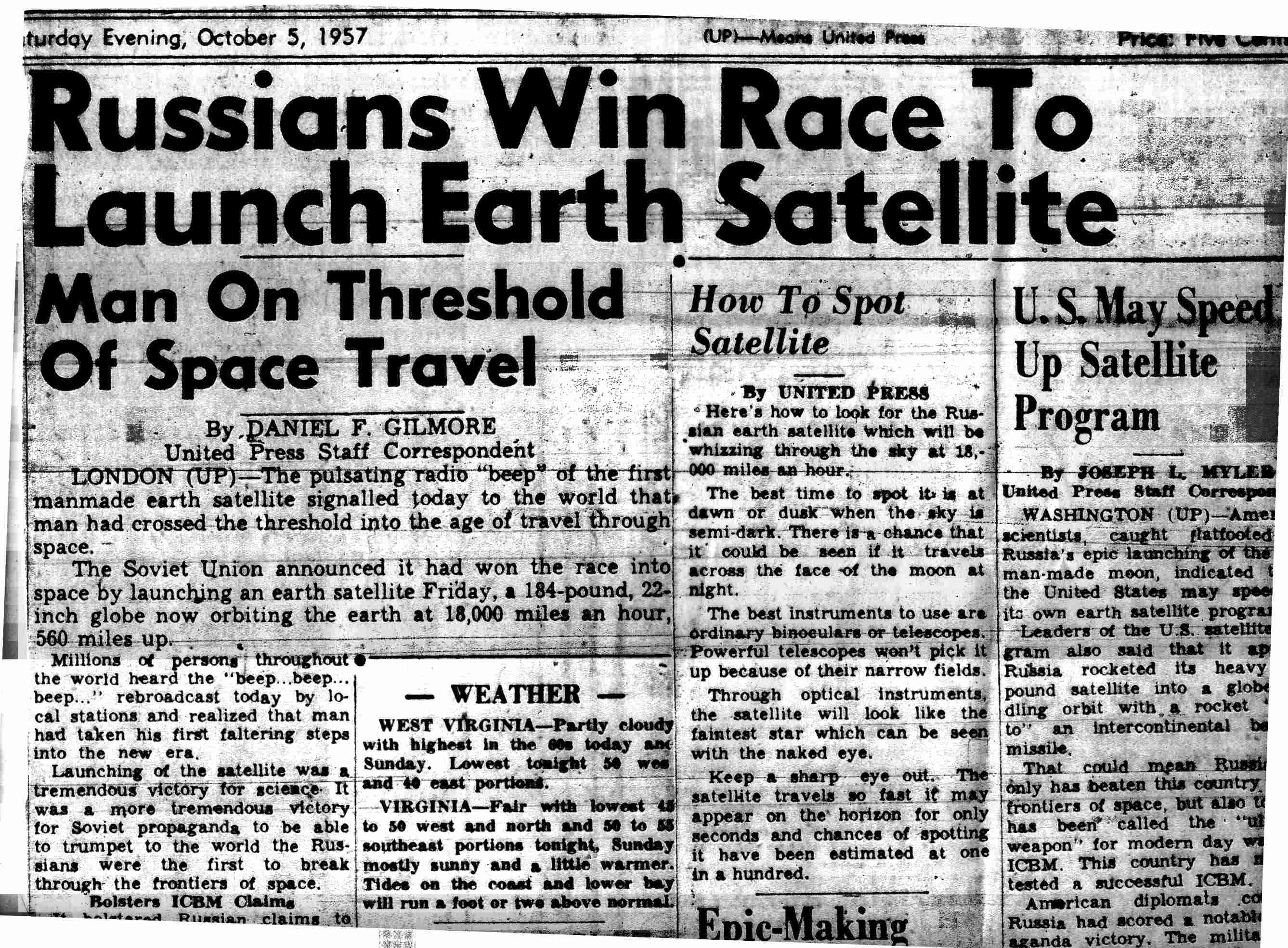
At the brink of the Space Race, on October 4th 1957, the Soviet Union successfully launched Sputnik 1 defeating the United States’ Project Vanguard to launch the first manmade satellite into orbit. Soon after in the following December 6th, Vanguard TV3 was launched. But just after four feet of ascend about two seconds after liftoff, the rocket fall back to the launch pad exploding and destroying itself damaging the launch pad along with it.

In response to the Sputnik Crisis and the spectacular televised failure of Vanguard TV3, the Advanced Research Projects Agency (ARPA) of the US Department of Defense was formed, now known as DARPA. The agency’s emphasis was initially centred to space, ballistic missile defence, and nuclear test detection. But it too had its focus on computers.

Many revolutionary technological inventions like the radar, the jet engine, and scientific innovations like the discovery of atomic fusion, were inventions fuelled by the features and capabilities which war necessitates. In the case, the Cold War necessitated to the Internet.

How it All Began
J.C.R. Licklider of MIT was the man with the vision. In 1962, he was chosen by the director of ARPA, Jack Ruina to join the agency to create and manage a programme for funding research to improve the military’s use of computer technology. He became the first director of the Command and Control Research Department at the agency, now known as the Information Processing Technologies Offices (IPTO). This was when he first wrote his memos on the Intergalactic Network or Galactic Network – the first ever concept of what is now known as the internet. He is especially famous for writing two papers, which were Man-Computer Symbiosis published in 1965 which speaks of the aims “let computers facilitate formulative thinking as they now facilitate the solution of formulated problems, and to enable men and computers to cooperate in making decisions and controlling complex situations without inflexible dependence on predetermined programs”, and The Computer as the Communication Device published in 1968 co-written by the successor of his successor, Ivan Sutherland, Robert W. Taylor.

Joseph Carl Robnett J.C.R Licklider Lick had the first vision of an Intergalactic Network now known as the Internet.

One of the first and most crucial inventions which lead to the development of the internet is packet switching, the process which breaks information or various numbers of data into ‘packets’ of data, which are then sent through the network or communication line individually. The term ‘switching’ refers to the discontinuity of the transferring of these packets through the network. A connected network of computers have many pathways to move information from one station to the next, and if a computer somewhere in the network disconnects, these independently travelling packets would individually find other routes to get to its target location, and this is what is meant by discontinuity. As all these packets reach their target, they are assembled back together as how they were before they left its source.


Lenoard Keinrock (left) in published a paper on digital message switching in 1961. Paul Barand (centre) and Donald Watts Davies (right) and independent invented packet switching in the early 60s.

The packet switching concept was a parallel invention in the early 60s first developed by Paul Baran of RAND (Research And Development) in the U.S. within the timeframe of ARPA in which he called ‘message-blocks’, and independently by Donald Davies at the National Physical Laboratory in the UK, in which he called ‘packet-switching’.

As an electrical engineer at RAND, Barand was asked to research into the survivability of the communications network for the U.S. Air Force. It was his 1964 paper titled On Distributed Communications which documents the breakthrough concept of packet switching. The paper describes the robustness of the communication system, whereby no matter how much damage was done to individual components of the network, without a central control and as long as the end-to-end communication is not lost, the information will still pass through. This was upmost important to military use as the Cold War was still ongoing. Although, there was an earlier research and a published a paper of relating field mostly on digital message switching in July of 1961 by Leonard Kleinrock titled Information Flow in Large Communications Net whom later played a major role in ARPA.

Lawrence G. Roberts (right) was persuaded by Robert William Bob Taylor (left) to join ARPA to become the ARPA IPTO Chief Scientist in December 1966.

In October 1966, Lawrence G. Roberts of MIT and head of Lincoln Laboratory published a paper titled Toward A Cooperative Network Of Time-Shared Computers. Roberts was persuaded by the third director of ARPA, Robert Taylor to leave MIT and join ARPA. Initially resisting, in December that year, he finally gave in as the ARPA IPTO Chief Scientist in December 1966. In 1967 Roberts, Baran and Davies became aware of each other’s work at an Association of Computing Machinery conference where they met and the term packet-switching was adopted. This is where ARPANET programme (ARPA Network programme) was first conceptualised based on Roberts’ paper and the packet switching technology.

It is August 30th, 1969 that marks the birth of ARPANET, the predecessor of the Internet, hence also the birth of the internet as well. An IMP (Interface Message Processor) was successfully delivered from BBN (originally Bolt, Beranek and Newma), a high-technology company which provides research and development services, to Klienrock’s Network Measurement Centre at UCLA (University of California, Los Angeles) becoming the first node of the ARPANET. The next nodes to emerge was SRI (Stanford Research Institute) and UCSB (University of California, Santa Barbara). Then more and more nodes emerged adding on to the network at a rate of around one per month. This was virtually unknown until the International Conference on Computer Communication in Washington DC in October 1972. By then, the ARPANET is no longer just about military use, and BBN from then until now remains a defence contractor for ARPA.

Competition between the Networks
The next field of the application of computing network after military use is education. Many institutions and universities started to develop their own network. Many other networks beside the ARPANET were developed for the purpose of quick data sharing, some of which are still extensively used until today and some no longer. ALOHAnet, for example, went into operation in 1970 at the University of Hawaii under the leadership of Norman Abramson which later connected to ARPANET in 1972, but it is no longer in use today. But Ethernet, which refers to the widely and still used today Local Area Network (LAN), is based on ALOHAnet’s protocol. BITNET, developed in 1981 by Ira H. Fuchs of City University of New York and Greydon Freeman of Yale University too faded away but did have a fare share of success around 1991 to 1992. But in the following years, it was later outnumbered by the number of connections to the successor of ARPANET, the Internet. By year 2000, BITNET’s remaining heritage mailing lists in regular use was a Blues music discussion group. Although, in 1988, BITNET did merge with another network the, CSNET (Computer and Science Research Network) to form CREN (Corporation for Research and Educational Networking) which is still somewhat in use today.

CSNET started its development in 1979, lead by L. H. Landweber and sponsored by the National Science Foundation, which helped introduce and popularised what was fast becoming the internet outside ARPANET to universities around the world. These universities naturally chose ARPANET’s network protocol, TCP/IP, which played a crucial role in ARPANET’s success. CSNET led directly to the development of the National Science Foundation Network (NSFNET). NSFNET was later officially dissolved on April 30th, 1995. Although, it did retained a core research network for research only use called the Very High Speed Backbone Network Service (vBNS).

Other networks which remain active until today are FidoNet and USENET. FidoNet is an amateur electronic mail network with over 15,000 mail nodes world wide, most publicly accessible Bulletin Board Systems (BBS) incorporated as a company in 1986. By 1998, FidoNet had about 30,000 nodes world wide, and it remains active into the 21'st century. USENET was developed in a similar manner to the other networks after ARPANET, where Jim Ellis and Tom Truscott, graduates from Duke University wanted similar capabilities of the mailing list on ARPANET for universities which weren’t doing research with the by-then-called DARPA, where in 1973, ‘D’ was added to stand for Defense and Research Project Agency. USENET was originally developed to share files between computers, but evolved into a net-wide hierarchy of the eight major categories plus a catch-call.


The advantage which ARPANET had over other networks is it being affiliated to BBN. What made ARPANET a stronger competitor among the networks were the invention of the E-mail and the development of the TCP/IP protocols, both advancements were from BBN developed in the 70s for ARPANET. This lead to other networks developing similar mailing and protocol systems of and for their own. Both E-mail and TCP/IP later became the standards of their type in the 80s. This one decade long duration of development to standardisation shows the resistance of other networks to make a switch from their own convention to the ARPANET’s convention.

ARPANET to Internet
The email was invented by Ray Tomlinson under BBN for ARPANET as part of a small group of programmers who were developing a time-sharing system called TENEX and was making improvements on a single-computer electronic mail programme called SNDMSG. The world’s first messages between two computers connected only by a computer network, the ARPANET, were sent in late 1971. The next release, TENEX, went out in early 1972 and included the version of SNDMSG with network mail capabilities. He develops the ‘user@host’ convention, choosing the ‘@’ sign arbitrarily from the non-alphabetic symbols on the keyboard. Other later networks with emailing capabilities chose other characters, and it was not until the late 1980s when ‘@’ finally become a worldwide standard.

 
Raymond Samuel Ray Tomilson invented the E-mail and implemented the famous '@' standard where the first email was sent in 1971.Vinton Gray Vint Cerf (left) and Robert Elliot Bob Kahn worked together under Lawrence G. Roberts to invent the TCP/IP protocol in 1973.

In 1973, Robert Kahn from BBN and Vint Cerf from Stanford joins the DARPA, to work for Lawrence Roberts in connecting ARPANET with other networks. By September 1973, the two gave their first paper on the new Transmission Control Protocol (TCP) at an International Network Working Group meeting (INWG meeting) at the University of Sussex, England. The term “internet” was adopted in the first RFC (Request for Comments) published on the TCP protocol, RFC 657. In technical terms, internet referrers to any network using the TCP/IP protocol.

Sooner, many other networks develop their own protocols, and it was only in 1984 onwards was when TCP/IP started its way to become world the standard. The US Department of Defence made the TCP/IP the standard for all military computer networking, which provided the protocol a higher profile and stable funding, and Dan Lynch and the Internet Architecture Board held a three day workshop on TCP/IP for the computer industry attended by about 50 researchers and 250 vendor representatives in 1985 which lead to several development of TCP/IP networking products by various companies. This is what lead to the development of the modern internet.

Before and Beyond
The previous services which the internet advanced from were of course those in the field of communications such as the electric telegraph, telephone, wireless telegraphy more commonly known as radio, and television. But as it did so from telegraph to telephone, telephone to radio and radio to television, the newer technologies simply outclassed the previous but not replace it, except for telegraphy-to-telephones. Although telephones completely made telegraphy obsolete, the submarine communications cables linking continents which used to carry telegraphy traffic now carries telephone traffic. Subsequently, the internet utilises and integrated with these telephone lines. In fact and clearly, the whole existence of the internet relied on the existence of telephones.

How the internet allowed the sharing and access of information with speed changed how the world operates.

Map of the internet (from Wikipedia)
Transforming mailing from the traditional use of using ink-and-paper for the content, and on-foot, vehicles, ships and aeroplanes for the sending, to electronic data for contents and mouse-clicks for the sending; from physical-travelling-to-purchase-products, to online shopping; from the tangible newspapers, to online news; from brick-walled three-to-four-stories libraries and archives, to search engines – Google especially; from personal paper-and-ink logbooks or diaries, to public electronic logs – web-logs, shortened to a more easily and quickly pronounced ‘blog’; from  text blogging, to online video blogging (vlog) with the video sharing website – YouTube; from board games, to massive multiplayer online and to virtual worlds – World of Warcraft and Second Life respectively; from paper printed encyclopaedias, to free easily accessible online encyclopaedias opened to be edited by anyone – Wikipedia; from conventional socialising, to online and virtual social networking – especially Facebook, becoming the world’s identity registry; and from online social networking, to frequent instant personal, company, media, news and celebrity updates via the phone – Twitter; the internet has truly transformed human civilisation into a Global Village.

If there is a technology in the line of communications which can surpass the internet, one could only speculate of a technology which provides network coverage across the solar system and beyond.
Print Friendly and PDF

Friday, 26 August 2011

World Education Ranking on Reading, Math and Science

An interesting data comparing the education of various countries:


From Gurdian's article World education rankings: which country does best at reading, maths and science?
Print Friendly and PDF

Tuesday, 23 August 2011

What Lay People Should Know about Cloning – Ethical and Legal Issues (technical) [Part 3]

by Zad Datu


Preceeding linked article (Read first!):
What Lay People Should Know about Cloning – Animal Reproductive Cloning
What Lay People Should Know about Cloning – Other Types of Cloning
What Lay People Should Know about Cloning – Fear Fuelled Objections (opinion) [Part 1] [Part 2]


Return to [Part 1 (of 3)]
Return to [Part 2 (of 3)]


Human Cloning Attempts
Panayiotis Michael “Panos” Zavos from Kentucky Center of Reproductive Medicine & IVF, a Greek Cypriot from Cyprus and American citizen currently living in Lexington, Kentucky is an infertility expert who has devoted well over a quarter of a decade to academia and research and has had a long career performing IVF, whom later founded Zavos Organization in Lexington, has been saying since 2001 that the time to clone a human is already.

On 9th March 2001, Zavos alongside Severino Antinori, a controversial Italian gynaecologist and fertility doctor from Rome who have already made headlines when he enabled a 62-year-old woman, Rosanna Dell Corte from Canino, Italy to give birth on July 18, 1994, who became the oldest mother to give birth at that time, announced that they are fully prepared to perform therapeutic human cloning, seven months before the first human cloned embryo was successful, which did not even survive to the blasocyst stage. They even claimed to have rounded up a team of scientists and doctors who are ready to clone a baby by the end of 2002. Regardless of the risks known in the animal cloning experiments, Zavos and Antinori insist that it is safe to proceed with human cloning.


Zavos announced before the US Congressional committee Hearing on 15th of May, 2002 of his intention to clone a human being and that “There is every indication that 2002 will be the year of the clones,” but admitted that he may not be the first to succeed. He also suggested that the best way to deal with the risks of human cloning is to legalise and regulate it instead of banning it all together, as regardless of bans someone, somewhere will attempt human cloning.

Since then, there have been many controversial human cloning claims most of which were unconvincing as they lacked evidence, causing international uproars, scorned and condemned upon by mainstream scientists, described as irresponsible and misusing genetic science:
  • April 2002: Early in the month, Severino Antinori announced his claim at a genetic engineering conference at Abu Dhabi that a woman is 8 weeks pregnant with the world’s first human clone. No evidence was presented. Even his own former partner, Panos Zavos claims that there have been “no clones, no laboratory, no patients and no doctors to help him,” and this severed their affiliation. But Antinori later he claimed that he had no involvement in the pregnancies – plural, not singular – and that there were three women in their 9th, 7th and 6th week of pregnancy, which he got to know of from other doctors.
  • 27 December 2002: Brigitte Boisselier, a Raelean bishop (a religious cult with the belief that Earth life was created by an extraterrestrial species) and CEO of Clonaid (a human cloning company run by the cult) announced that a 31-year-old American woman gave birth to her own clone named Eve – another world’s first cloned human baby. With no surprise that no evidence was presented.
  • 17 January 2004: Zavos announced at a news conference in a central London hotel claimed to have implanted cloned embryos into a woman’s womb. Zavos said that it was too early to determine if the implantation is successful. Zavos published a paper on this procedure and claimed that the procedure was filmed by independent filmmaker, Peter Williams, and that DNA testing can be performed to confirm his claim. It was later revealed on 4th February that the attempt failed – that pregnancy did not take place.
In response to the numerous non credible claims, on January 21st 2004, the British scientific community and the Human Fertilization and Embryology Authority (HFEA) made a request to news editors in the UK not to give press coverage to Zavos’s cloning efforts and to “reconsider the prominence given to repeated claims by certain scientists that they have cloned a human being, including those made by Dr. Panos Zavos last weekend”.  The letter was signed by qualified scientists from many reputable institutions. Zavos took the effort to defend himself during the 31st August press conference later that year, which is meticulously presented in his webpage http://www.zavos.org/library/library_hfea.htm.
  • May 2004: Antinori restates his April 2002 claim of the three pregnancies at a press conference on reproductive technology in Rome still denying his involvement but that he only gave a ‘cultural and scientific contribution’ and confirming the births and that he knows they went well and confirming the fact exists whilst refusing to provide further details or evidence.
  • August 2004: Zavos claimed to have cloned human embryos once again, but from the DNA of two corpses belonging to victims of road accidents – Cady, an 11-year old girl and a 33-year old man – then implanting them into a woman’s womb, and once again it was filmed by Peter Williams and has published his work in an online medical journal run by one of the pioneers of IVF. Zavos later revealed that the surrogate mother failed be impregnated. Regardless of condemnations, Zavos sees himself to be helping families to create a genetic replica of loved ones who have passed away.
  • 2004 – 2006: Zavos have been publishing experimented on interspecies cloned embryos of human DNA from a man but an oocyte of a bovine (subfamily Bovinae, which includes cattle, bison, buffalo, yaks and antelopes) for research and practicing purposes as has been conducted by other scientists. He insists that he never intends to implant an interspecies clone for reproduction nor does he think it should ever be done.
  • Early March 2009: Antinori once again restates his 2002 claim, this time to Italy’s Oggi magazine, boastfully saying “I helped give birth to three children with the human cloning technique,” and “It involved two boys and a girl who are nine years old today,” adding and “they were born healthy and they are in excellent health now,” and that they are now living in Eastern Europe without providing evidence once again.
  • April 2009: Zavos attempted to clone Cady once again this time produce 14 embryos and implanted 11 of them into the wombs of 4 women who were paid up to £50,000, three of which were couples, one British, and the fourth was a single woman. As usual, no proof was provided nor did he submit any scientific publication. This again was filmed by Peter Williams (many of his films on Zavos procedure were presented on Discovery Channel) who testified the legitimacy of the procedure for reproductive purposes to The Independent adding that the women were genuinely hoping to become pregnant. But once again, all failed to achieve pregnancy. The location of the procedure is secret but is speculated to be in the Middle East.


Human Cloning Debates
Instead of allowing a sperm to fertilise with an egg, cloning uses a nucleus of a completely different kind of cell. Instead of having a sperm to fertilise the egg, electrocution is used. In cloning the chromosome of the ovum is removed and what else is removed along with that isn’t something we are entirely sure of.  Performing all these unnatural processes to produce and offspring is very likely to be of higher risk than that of natural processes. To assume safety is to be irresponsible, most scientists would say.

With the uncertainties of cloning we are yet to solve, cloning humans is just like using humans as guinea pigs for the cloning procedure. Even if the clones appear completely normal at the early stage of life, it is still very likely that abnormality and deformities as a result of cloning would appear in the later years of life, just as they do currently in animals. Zavos argues that since there already is a 3% - 4% of genetic abnormality for natural sexual reproduction, the imperfection from human cloning is just another form to live with.

Many dismiss Zavos’s TV documentary effort as simply attention seeking. Zavos argues that there is a demand for media coverage by the public in the field of human cloning and that advances in the technology should be presented to better inform the public to educate the public to decide for themselves whether they are against or for reproductive cloning. He states that many oppose human cloning out of the fear of what they do not know. Zavos, who claims to have inquiries from around 100 potential patients, truly believes that human cloning can brighten up the life of many infertile couples. He has receive inquiries to participate at international forums to present his data and have attended numerous press conference and interviews and intend to do so more in the future to educate the public on the technology.

Both sides agree that all the cloning experiments performed thus far are on animals and that they resulted in a high percentage of birth defects. It is the interpretation of this is what both sides don’t agree with. The human cloning proponents interprets this as that these birth defects may occur to human cloning as well if attempted, and that since that there are no cloning technique on animals which has a high success rate in developing normal babies, no one can guarantee a human cloning technique of high success rate especially that there hasn’t been any experiments on human cloning – that the implications of attempting to clone a human at this stage of cloning technology is unimaginable and it would be completely irresponsible to do so.

But Zavos interprets it otherwise. There are many instances in countless numbers of interviews where he states that just because all these birth defects occurs in animals, it doesn’t mean that it will occur in humans. He says that with over 25 years of experience working with human embryos in IVF procedures in his expertise, he can use the advance fertilization techniques which animal cloning procedures do not utilise, hence the chances of successfully producing a normal human clone is higher than that of animals. He obviously seems to think that he, who has never performed cloning – not even on animals – claims to know better about human cloning than the scientists who have been performing cloning on animals since Dolly in 1997 does. Whether his confidence and optimism is a result of flawed assumption or not is up to anyone to decide, but majority of the scientific community, even cloning experts, condemn his human cloning attempts.


Dr. Zavos has also said that he is against the idea of creating human embryos to experiment on them, then killing it. This is partially the reason why he wishes to go for the ‘instant success’ path and produce a normal human clone. But the first attempt of ‘instant success’ cloned baby would be a human guinea pig. This is why nobody, except for Zavos, dares to clone a human. Most scientists would prefer to have the perfect low risk animal cloning technique in their hands before attempting to try it on humans which sounds perfectly reasonable, but Zavos obviously seems to think that this is unnecessary.

Zavos remains firm that he does not intend to create deformed babies or break any laws. He will perform cloning in countries where cloning is not banned, but refuses to reveal where, and that the embryos will be thoroughly tested for chromosomal and other defects before implanting them and will abandon the procedure if any form of defects is discovered.
Print Friendly and PDF